Why You’ll Love This Chocolate Macarons
If you’ve ever been intimidated by making french macarons at home, this easy chocolate macaron recipe is about to change your baking game. These delicate, elegant cookies have a reputation for being difficult, but with the right guidance and this straightforward method, you can create bakery-quality chocolate macarons in your own kitchen. Here’s why this recipe deserves a special place in your baking repertoire:- Ease of preparation: This recipe breaks down the seemingly complex process into manageable steps that even beginners can follow. With clear instructions and helpful tips, you’ll master the macaronage technique and create perfect shells without the stress often associated with french macarons. The total active prep time is just about 45 minutes, with most of the time spent waiting for the shells to rest or bake, allowing you to multitask in the kitchen.
- Health benefits: While chocolate macarons are certainly an indulgent treat, they can be part of a balanced diet when enjoyed in moderation. The benefits of chocolate are well-documented, especially when using dark chocolate with a high cacao percentage, which contains antioxidants and may support heart health. Additionally, the almonds in the flour provide protein, fiber, and healthy fats. Making your own macarons allows you to control the quality of ingredients and potentially reduce the sugar content compared to store-bought versions.
- Versatility: This chocolate macaron recipe serves as a fantastic base for endless variations. Once you master the basic technique, you can easily adapt it to different dietary needs and flavor preferences. The chocolate shells pair beautifully with various fillings beyond chocolate ganache, including fruit preserves, buttercream, or even something lighter like the no-bake energy bites flavors you might already enjoy. The recipe can be modified for gluten-free diets (it naturally contains no wheat), and with a few simple substitutions, it can accommodate vegan and keto preferences as well.
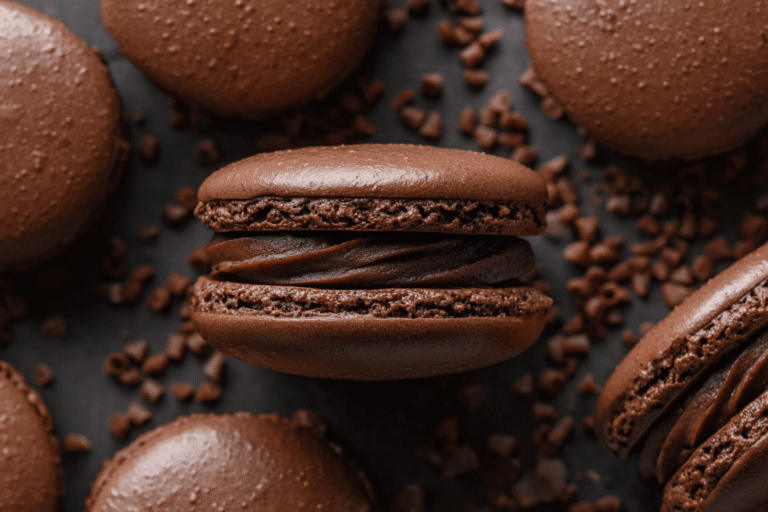
- Distinctive flavor: These chocolate macarons offer a perfect balance of rich chocolate flavor with a delicate, slightly crisp exterior and a chewy, fudgy interior. The combination of cocoa powder in the shells and a rich chocolate ganache filling creates an intense chocolate experience that satisfies serious chocolate lovers. The refined sweetness, beautiful glossy finish, and elegant appearance make these perfect for special occasions, gifts, or simply as an impressive treat to enjoy with your afternoon coffee or tea.
Jump to:
- Why You’ll Love This Chocolate Macarons
- Essential Ingredients for Chocolate Macarons
- For the Macaron Shells:
- For the Chocolate Ganache Filling:
- Special Dietary Options:
- Vegan Substitutions:
- Gluten-Free Options:
- Low-Calorie Options:
- How to Prepare the Perfect Chocolate Macarons: Step-by-Step Guide
- Preparation Before You Begin
- Creating the Dry Ingredient Mixture
- Preparing the Meringue
- Mastering the Macaronage Technique
- Piping the Macaron Shells
- Baking the Macarons
- Preparing the Chocolate Ganache
- Assembling the Chocolate Macarons
- Dietary Substitutions to Customize Your Chocolate Macarons
- Vegan Options:
- Gluten-Free Options:
- Other Variations:
- Expert Tips for Perfect Macarons Every Time
- Storage, Freezing, and Serving Suggestions
- Room Temperature Storage
- Refrigeration
- Freezing
- Serving Ideas
- Nutritional Information and FAQ
- How do you make chocolate macarons at home?
- Why did my chocolate macarons crack in the oven?
- What ingredients do I need for chocolate macarons?
- How do you store chocolate macarons?
- What’s the best ganache filling for chocolate macarons?
- Chocolate Macarons
- Ingredients
- Instructions
- Last Step:
- Notes
- Nutrition
- Did you make this recipe?
Essential Ingredients for Chocolate Macarons
Creating perfect chocolate macarons requires precision in both measurements and technique. Each ingredient plays a crucial role in the texture, appearance, and flavor of these delicate cookies. Here’s a comprehensive list of everything you’ll need to make approximately 20-24 filled macarons:For the Macaron Shells:
- 100g almond flour – The foundation of the macaron shell, providing structure and a subtle nutty flavor
- 100g powdered sugar – Creates the smooth, delicate texture and helps form the crispy exterior
- 10g unsweetened cocoa powder – Adds the rich chocolate flavor and the characteristic dark color
- 75g egg whites (about 2-3 large whites) – Aged overnight for better stability and volume
- 100g granulated sugar – Stabilizes the meringue and adds sweetness to balance the cocoa
- 1/4 teaspoon cream of tartar – Helps stabilize the egg whites and ensures a glossy meringue
For the Chocolate Ganache Filling:
- 200g dark chocolate (60-70% cacao) – Finely chopped for even melting and rich flavor
- 100g heavy cream – Creates the silky, smooth texture of the ganache
- 1 teaspoon unsalted butter (optional) – Adds shine and a luxurious mouthfeel
- 1 teaspoon vanilla extract (optional) – Enhances the chocolate flavor
- Pinch of sea salt – Balances the sweetness and intensifies the chocolate taste
Special Dietary Options:
Vegan Substitutions:
- Replace egg whites with aquafaba (liquid from canned chickpeas) in a 1:1 ratio
- Use creamed coconut or coconut cream instead of heavy cream for the ganache
- Ensure your chocolate is dairy-free/vegan certified
Gluten-Free Options:
- This recipe is naturally gluten-free as it uses almond flour instead of wheat flour
- Double-check that your powdered sugar and cocoa powder are certified gluten-free if needed
- Use certified gluten-free dark chocolate if you have severe gluten sensitivity
Low-Calorie Options:
- Substitute erythritol or a natural sweetener blend for the granulated sugar
- Use a lighter filling like sugar-free chocolate mousse or a fruit-based alternative
- Make smaller macarons to reduce the overall calorie count per serving
How to Prepare the Perfect Chocolate Macarons: Step-by-Step Guide
Making chocolate macarons is a rewarding process that becomes easier with practice. This comprehensive guide will walk you through each step of creating beautiful, professional-looking french macarons at home. Remember that precision and patience are key to success with these delicate cookies.Preparation Before You Begin
First Step: Gather all your ingredients and equipment. You’ll need a kitchen scale for precise measurements, a food processor or blender, a fine-mesh sieve, a stand mixer or hand mixer, a piping bag with a round tip (about 1/4 inch), and baking sheets lined with parchment paper or silicone baking mats. It’s crucial to weigh all your ingredients rather than using volume measurements, as even small variations can affect the outcome. Prepare your baking sheets by drawing 1.5-inch circles about 2 inches apart on the parchment paper as guides for piping. Flip the paper over so the ink doesn’t touch the macarons.Creating the Dry Ingredient Mixture
Second Step: Process the dry ingredients to ensure a smooth texture. In a food processor, combine the almond flour, powdered sugar, and cocoa powder. Pulse several times until the mixture is very fine and well combined. Sift the mixture through a fine-mesh sieve into a large bowl, pressing any larger pieces through with the back of a spoon. This step is essential to prevent lumps and achieve the characteristic smooth tops of perfect macarons. If there are more than 1-2 tablespoons of almond pieces that won’t pass through the sieve, return them to the food processor and pulse again, then re-sift. The nutritional benefits of almonds make this step worth the extra effort.Preparing the Meringue
Third Step: Begin making the meringue by ensuring your egg whites are at room temperature. In the clean, grease-free bowl of a stand mixer fitted with the whisk attachment, beat the egg whites and cream of tartar on medium speed until foamy. Gradually add the granulated sugar one tablespoon at a time while continuing to beat. Increase the speed to medium-high and continue beating until stiff, glossy peaks form. The meringue should hold its shape when the whisk is lifted and should not slide out of the bowl when tilted. This process typically takes 5-7 minutes with a stand mixer or slightly longer with a hand mixer.Mastering the Macaronage Technique
Fourth Step: This is perhaps the most critical step in making chocolate macarons. Add about one-third of the dry ingredient mixture to the meringue and gently fold with a rubber spatula. Use a folding motion scraping around the sides of the bowl and cutting through the middle rather than stirring. Once incorporated, add the remaining dry ingredients and continue folding. The goal is to deflate the meringue just enough to achieve the proper consistency. After about 40-50 folds, the batter should flow slowly off the spatula in a continuous ribbon and form a figure-8 that holds its shape for a moment before dissolving back into the batter. This consistency, often described as “like lava,” ensures proper spreading without the batter running too much. Undermixing will result in macarons with peaks, while overmixing will cause flat, spread-out cookies.Piping the Macaron Shells
Fifth Step: Transfer the batter to a piping bag fitted with a round tip. Hold the bag perpendicular to the baking sheet, about 1/2 inch above the surface. Apply steady pressure to pipe circles onto the prepared baking sheets, following your traced guides as templates. Stop piping when you reach the edge of the circle, then quickly twist your wrist to cut the flow and lift the bag away. Once all the macarons are piped, firmly tap the baking sheets against the counter 3-4 times to release any air bubbles trapped in the batter. You may see small bubbles rise to the surface use a toothpick to pop them if necessary. Let the piped shells rest at room temperature for 30-60 minutes, until they form a skin and are dry to the touch. This resting period allows the shells to develop their characteristic “feet” during baking and prevents cracking.Baking the Macarons
Sixth Step: While the macarons are resting, preheat your oven to 300°F (150°C) with at least one oven rack in the center position. If you have an oven thermometer, use it to ensure accuracy, as temperature fluctuations can affect the outcome. Bake the macarons one sheet at a time for 15-18 minutes, rotating the pan halfway through the baking time. The macarons are done when they no longer wiggle when gently touched, and the feet are visible and set. The tops should be smooth and not browned. Remove from the oven and let the macarons cool completely on the baking sheets before attempting to remove them. They should release easily from the parchment paper when fully cooled.Preparing the Chocolate Ganache
Seventh Step: While the macaron shells are cooling, prepare the ganache filling. Place the chopped dark chocolate in a heat-proof bowl. Heat the heavy cream in a small saucepan over medium heat until it just begins to simmer small bubbles should form around the edges, but it should not come to a full boil. Pour the hot cream over the chocolate and let it sit for 2 minutes without stirring. After 2 minutes, gently stir with a spatula starting from the center and working outward, continuing until the chocolate is completely melted and the ganache is smooth and glossy. If using, add the butter, vanilla extract, and salt, stirring until fully incorporated. Let the ganache cool at room temperature for 1-2 hours, or refrigerate for 30-45 minutes, until it reaches a spreadable consistency similar to peanut butter.Assembling the Chocolate Macarons
Final Step: Once the macaron shells are completely cool and the ganache has reached the right consistency, it’s time to assemble your chocolate macarons. Transfer the ganache to a piping bag fitted with a small round tip or simply use a small offset spatula. Pair up the shells by matching similarly sized halves. Pipe or spread a small amount of ganache (about 1 teaspoon) onto the flat side of one shell, then gently place another shell on top, pressing lightly to spread the filling to the edges without cracking the shell. Repeat until all macarons are filled. For the best flavor and texture, let the assembled macarons mature in the refrigerator for 24 hours before serving. This resting period allows the flavors to meld and the texture to become chewy and fudgy. Bring to room temperature for 15-20 minutes before serving for the optimal taste experience.
Dietary Substitutions to Customize Your Chocolate Macarons
One of the wonderful aspects of homemade chocolate macarons is their adaptability to various dietary needs and preferences. With a few strategic substitutions, almost anyone can enjoy these elegant treats. Here are detailed options for customizing this recipe:Vegan Options:
- Aquafaba instead of egg whites: The liquid from canned chickpeas, known as aquafaba, makes an excellent plant-based substitute for egg whites in macarons. Use the same weight measurement (75g) and whip it exactly as you would egg whites, adding the sugar gradually. It may take slightly longer to reach stiff peaks, so be patient. The resulting macarons will have the same delicate texture and structure.
- Coconut cream for ganache: Replace heavy cream with full-fat coconut cream in a 1:1 ratio. Chill a can of coconut milk overnight, then scoop out the solid cream from the top. Heat this as you would regular cream and pour over your vegan chocolate. The ganache may have a subtle coconut flavor, which pairs beautifully with chocolate, or you can use refined coconut oil for a neutral taste.
- Vegan chocolate: Ensure you’re using chocolate that contains no milk products. Many dark chocolates are naturally vegan, but always check the label. Brands specializing in vegan chocolate often produce excellent options with high cocoa content that work perfectly for ganache.
Gluten-Free Options:
- Naturally gluten-free base: Traditional macarons made with almond flour are naturally gluten-free, making them an excellent option for those with celiac disease or gluten sensitivity. However, cross-contamination can occur during processing, so look for certified gluten-free almond flour and powdered sugar if you have severe reactions.
- Alternative nut flours: While almond flour is traditional, you can experiment with other nut flours like hazelnut, cashew, or pistachio for different flavor profiles. Keep in mind that different nut flours have varying oil contents, which may slightly affect the texture. Start with a small test batch when trying alternatives.
Other Variations:
- Nut-free: For those with nut allergies, sunflower seed flour or pumpkin seed flour can replace almond flour. These alternatives have a slightly different texture and may result in macarons with a more pronounced grain. The color may also be different sunflower seeds can turn green when baked, especially with cocoa. Consider adding a touch of red food coloring to neutralize this effect.
- Low-sugar: Replace the granulated sugar in the meringue with powdered erythritol or a blend of natural sweeteners designed for baking. Keep in mind that sugar provides structure to macarons, so complete elimination isn’t recommended. For the ganache, use unsweetened chocolate and sweeten with a liquid stevia or monk fruit sweetener to taste.
- Keto: Create keto-friendly macarons by substituting powdered sweetener for both the granulated and powdered sugar. Almond flour is already keto-friendly, and you can use a high-percentage dark chocolate (85% or higher) sweetened with stevia for the ganache. The resulting macarons will have a slightly different texture but still deliver that satisfying chocolate flavor.
When making these substitutions, understand that the texture and taste may vary slightly from traditional macarons. Practice with small batches first to perfect your technique before making larger quantities for special occasions. Remember that temperature and humidity affect all macarons, regardless of substitutions, so pay attention to these factors as well.
Expert Tips for Perfect Macarons Every Time
Even experienced bakers sometimes face challenges when making chocolate macarons. These professional tips will help you avoid common pitfalls and consistently produce beautiful, delicious macarons:
- Macaronage technique: Mastering the proper folding technique is crucial. Aim for 40-50 folds, checking the consistency frequently. The batter should flow like lava and form a figure-8 that holds its shape for a moment before dissolving. Undermixed batter will have peaks and result in hollow macarons, while overmixed batter will spread too much and create flat cookies. Practice makes perfect don’t be discouraged if your first attempt isn’t flawless.
- Aging egg whites: Separate your egg whites 24-48 hours before baking and leave them uncovered in the refrigerator. This allows moisture to evaporate, creating stronger, more stable meringue. Before using, bring them to room temperature for about 30 minutes. This aging process significantly reduces the risk of hollow shells and improves the overall structure of your macarons.
- Oven temperature accuracy: Home ovens often have inaccurate temperature readings, which can spell disaster for delicate macarons. Invest in an inexpensive oven thermometer to verify the actual temperature. Macarons generally bake best between 295°F and 305°F (146°C-152°C). If your macarons are browning too quickly, your oven may be running hot, while pale macarons without feet might indicate an oven that’s too cool.
- Avoiding cracks: Cracked macarons are often caused by skipping the resting period or baking at too high a temperature. Always let your piped shells rest until they form a dry skin usually 30-60 minutes, but longer in humid conditions. Test by lightly touching a shell; if no batter sticks to your finger, they’re ready to bake. A properly formed skin allows the macarons to rise evenly and develop feet without cracking.
- Resting shells: The resting period is not optional it’s essential for proper structure formation. During this time, the surface of the macaron dries, creating a membrane that allows steam to escape from the bottom during baking, forming the characteristic “feet.” In humid weather, you might need to extend the resting time or use a dehumidifier in the kitchen. Some bakers also use a fan on low setting to speed up the process, though this can sometimes cause uneven drying.
- Ganache filling best practices: For the smoothest ganache, chop your chocolate into uniform, small pieces before pouring the hot cream over it. This ensures even melting. Avoid using a whisk, which can incorporate air bubbles into the ganache. Instead, gently stir with a spatula from the center outward. Let the ganache cool completely before piping if it’s too warm, it will melt the macaron shells; if too cold, it won’t spread properly between the cookies.
- Troubleshooting common issues: If your macarons are hollow, you may have undermixed the batter or baked at too low a temperature. Stuck macarons indicate underbaking or too much moisture in the batter try increasing baking time by 1-2 minutes or sifting your dry ingredients more thoroughly. Lopsided macarons often result from uneven oven heat or tilted baking sheets. Always use an oven thermometer and rotate pans halfway through baking for even results.
Storage, Freezing, and Serving Suggestions
Proper storage is essential for maintaining the delicate texture and flavor of your chocolate macarons. Follow these guidelines to keep your macarons fresh and enjoyable:
Room Temperature Storage
Store chocolate macarons in an airtight container at room temperature for up to 3 days. Place a piece of parchment paper between layers to prevent sticking. Keep the container away from direct sunlight and heat sources, which can cause the ganache to soften and the shells to become soggy. Macarons actually taste better after sitting for 24 hours, as this allows the flavors to meld and the moisture from the filling to soften the shells slightly, creating that perfect chewy-crisp texture contrast.
Refrigeration
For longer storage, refrigerate chocolate macarons in an airtight container for up to 1 week. As with room temperature storage, layer with parchment paper to prevent sticking. The ganache will firm up in the refrigerator, so remove the macarons 15-20 minutes before serving to allow them to come to room temperature and the filling to soften slightly. Avoid storing macarons in the refrigerator door, where temperature fluctuations are more common.
Freezing
Chocolate macarons freeze exceptionally well for up to 1 month. Place unfilled shells or filled macarons in a single layer on a baking sheet and freeze until solid, then transfer to a freezer-safe container or bag. Separate layers with parchment paper to prevent sticking. Label the container with the date and contents. To thaw, place the container in the refrigerator for several hours or overnight, then let the macarons come to room temperature for about 30 minutes before serving. For the best texture, consider freezing unfilled shells and filling them after thawing.
Serving Ideas
Present chocolate macarons on a decorative platter or tiered stand for an elegant dessert display. They pair beautifully with espresso, cappuccino, or a glass of dessert wine. For a special presentation, arrange macarons in a circular pattern with fresh berries or edible flowers in the center. These delicate cookies also make impressive gifts when packaged in a clear box with a beautiful ribbon. Consider pairing chocolate macarons with complementary flavors like raspberry, orange, or mint for a sophisticated dessert course. For a casual treat, enjoy them with a simple glass of cold milk or your favorite fruit smoothie to balance the richness.
Nutritional Information and FAQ
How do you make chocolate macarons at home?
Why did my chocolate macarons crack in the oven?
What ingredients do I need for chocolate macarons?
How do you store chocolate macarons?
What’s the best ganache filling for chocolate macarons?
Chocolate Macarons
🍫 Crispy almond-meringue shells sandwich rich chocolate ganache for a melt-in-your-mouth treat loaded with antioxidants from cocoa.
🧁 Foolproof step-by-step guide yields bakery-perfect macarons at home, ideal for gifting, parties, or indulgent afternoons!
- Total Time: 3 hours
- Yield: 30 macarons
Ingredients
– 100g almond flour for structure and subtle nutty flavor
– 100g powdered sugar for smooth delicate texture and crispy exterior
– 10g unsweetened cocoa powder for rich chocolate flavor and dark color
– 75g egg whites (about 2-3 large whites) for stability and volume
– 100g granulated sugar for stabilizing meringue and sweetness
– 1/4 teaspoon cream of tartar for stabilizing egg whites and glossy meringue
– 200g dark chocolate (60-70% cacao) for even melting and rich flavor
– 100g heavy cream for silky smooth texture
– 1 teaspoon unsalted butter (optional) for shine and luxurious mouthfeel
– 1 teaspoon vanilla extract (optional) for enhancing chocolate flavor
– Pinch of sea salt for balancing sweetness and intensifying chocolate taste
Instructions
1-First Step: Gather all your ingredients and equipment. You’ll need a kitchen scale for precise measurements, a food processor or blender, a fine-mesh sieve, a stand mixer or hand mixer, a piping bag with a round tip (about 1/4 inch), and baking sheets lined with parchment paper or silicone baking mats. It’s crucial to weigh all your ingredients rather than using volume measurements, as even small variations can affect the outcome. Prepare your baking sheets by drawing 1.5-inch circles about 2 inches apart on the parchment paper as guides for piping. Flip the paper over so the ink doesn’t touch the macarons.
2-Second Step: Process the dry ingredients to ensure a smooth texture. In a food processor, combine the almond flour, powdered sugar, and cocoa powder. Pulse several times until the mixture is very fine and well combined. Sift the mixture through a fine-mesh sieve into a large bowl, pressing any larger pieces through with the back of a spoon. This step is essential to prevent lumps and achieve the characteristic smooth tops of perfect macarons. If there are more than 1-2 tablespoons of almond pieces that won’t pass through the sieve, return them to the food processor and pulse again, then re-sift. The nutritional benefits of almonds make this step worth the extra effort.
3-Third Step: Begin making the meringue by ensuring your egg whites are at room temperature. In the clean, grease-free bowl of a stand mixer fitted with the whisk attachment, beat the egg whites and cream of tartar on medium speed until foamy. Gradually add the granulated sugar one tablespoon at a time while continuing to beat. Increase the speed to medium-high and continue beating until stiff, glossy peaks form. The meringue should hold its shape when the whisk is lifted and should not slide out of the bowl when tilted. This process typically takes 5-7 minutes with a stand mixer or slightly longer with a hand mixer.
4-Fourth Step: This is perhaps the most critical step in making chocolate macarons. Add about one-third of the dry ingredient mixture to the meringue and gently fold with a rubber spatula. Use a folding motion scraping around the sides of the bowl and cutting through the middle rather than stirring. Once incorporated, add the remaining dry ingredients and continue folding. The goal is to deflate the meringue just enough to achieve the proper consistency. After about 40-50 folds, the batter should flow slowly off the spatula in a continuous ribbon and form a figure-8 that holds its shape for a moment before dissolving back into the batter. This consistency, often described as “like lava,” ensures proper spreading without the batter running too much. Undermixing will result in macarons with peaks, while overmixing will cause flat, spread-out cookies.
5-Fifth Step: Transfer the batter to a piping bag fitted with a round tip. Hold the bag perpendicular to the baking sheet, about 1/2 inch above the surface. Apply steady pressure to pipe circles onto the prepared baking sheets, following your traced guides as templates. Stop piping when you reach the edge of the circle, then quickly twist your wrist to cut the flow and lift the bag away. Once all the macarons are piped, firmly tap the baking sheets against the counter 3-4 times to release any air bubbles trapped in the batter. You may see small bubbles rise to the surface use a toothpick to pop them if necessary. Let the piped shells rest at room temperature for 30-60 minutes, until they form a skin and are dry to the touch. This resting period allows the shells to develop their characteristic “feet” during baking and prevents cracking.
6-Sixth Step: While the macarons are resting, preheat your oven to 300°F (150°C) with at least one oven rack in the center position. If you have an oven thermometer, use it to ensure accuracy, as temperature fluctuations can affect the outcome. Bake the macarons one sheet at a time for 15-18 minutes, rotating the pan halfway through the baking time. The macarons are done when they no longer wiggle when gently touched, and the feet are visible and set. The tops should be smooth and not browned. Remove from the oven and let the macarons cool completely on the baking sheets before attempting to remove them. They should release easily from the parchment paper when fully cooled.
7-Seventh Step: While the macaron shells are cooling, prepare the ganache filling. Place the chopped dark chocolate in a heat-proof bowl. Heat the heavy cream in a small saucepan over medium heat until it just begins to simmer small bubbles should form around the edges, but it should not come to a full boil. Pour the hot cream over the chocolate and let it sit for 2 minutes without stirring. After 2 minutes, gently stir with a spatula starting from the center and working outward, continuing until the chocolate is completely melted and the ganache is smooth and glossy. If using, add the butter, vanilla extract, and salt, stirring until fully incorporated. Let the ganache cool at room temperature for 1-2 hours, or refrigerate for 30-45 minutes, until it reaches a spreadable consistency similar to peanut butter.
8-Final Step: Once the macaron shells are completely cool and the ganache has reached the right consistency, it’s time to assemble your chocolate macarons. Transfer the ganache to a piping bag fitted with a small round tip or simply use a small offset spatula. Pair up the shells by matching similarly sized halves. Pipe or spread a small amount of ganache (about 1 teaspoon) onto the flat side of one shell, then gently place another shell on top, pressing lightly to spread the filling to the edges without cracking the shell. Repeat until all macarons are filled. For the best flavor and texture, let the assembled macarons mature in the refrigerator for 24 hours before serving. This resting period allows the flavors to meld and the texture to become chewy and fudgy. Bring to room temperature for 15-20 minutes before serving for the optimal taste experience.
Last Step:
Please leave a rating and comment letting us know how you liked this recipe! This helps our business to thrive and continue providing free, high-quality recipes for you.Notes
🏠 Weigh ingredients for precision—macarons are finicky!
💨 Use aged egg whites (left out overnight) for stable meringue.
🌡️ Oven thermometer ensures accurate 300°F for perfect feet.
- Prep Time: 45 minutes
- Rest & Chill Time: 2 hours
- Cook Time: 18 minutes
- Category: Dessert
- Method: Baking
- Cuisine: French
- Diet: Vegetarian, Gluten-Free
Nutrition
- Serving Size: 1 macaron
- Calories: 90 kcal
- Sugar: 9g
- Sodium: 10mg
- Fat: 6g
- Saturated Fat: 2g
- Unsaturated Fat: 3g
- Trans Fat: 0g
- Carbohydrates: 10g
- Fiber: 1g
- Protein: 2g
- Cholesterol: 5mg