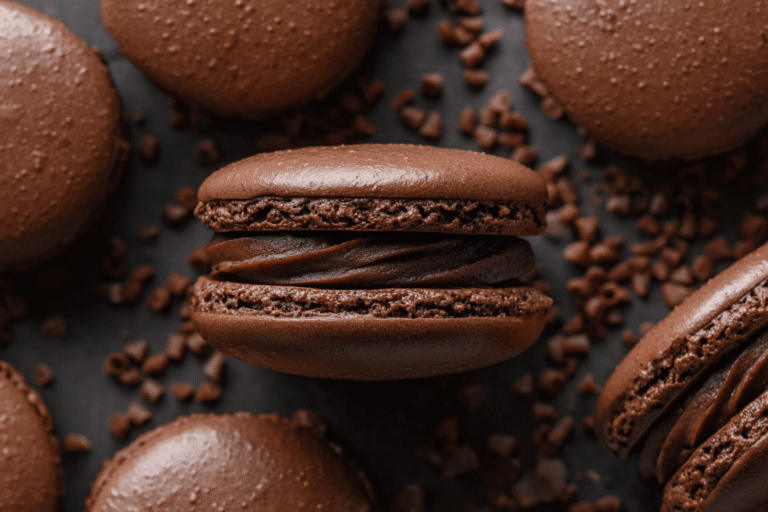
Ingredients
– 100g almond flour for structure and subtle nutty flavor
– 100g powdered sugar for smooth delicate texture and crispy exterior
– 10g unsweetened cocoa powder for rich chocolate flavor and dark color
– 75g egg whites (about 2-3 large whites) for stability and volume
– 100g granulated sugar for stabilizing meringue and sweetness
– 1/4 teaspoon cream of tartar for stabilizing egg whites and glossy meringue
– 200g dark chocolate (60-70% cacao) for even melting and rich flavor
– 100g heavy cream for silky smooth texture
– 1 teaspoon unsalted butter (optional) for shine and luxurious mouthfeel
– 1 teaspoon vanilla extract (optional) for enhancing chocolate flavor
– Pinch of sea salt for balancing sweetness and intensifying chocolate taste
Instructions
1-First Step: Gather all your ingredients and equipment. You’ll need a kitchen scale for precise measurements, a food processor or blender, a fine-mesh sieve, a stand mixer or hand mixer, a piping bag with a round tip (about 1/4 inch), and baking sheets lined with parchment paper or silicone baking mats. It’s crucial to weigh all your ingredients rather than using volume measurements, as even small variations can affect the outcome. Prepare your baking sheets by drawing 1.5-inch circles about 2 inches apart on the parchment paper as guides for piping. Flip the paper over so the ink doesn’t touch the macarons.
2-Second Step: Process the dry ingredients to ensure a smooth texture. In a food processor, combine the almond flour, powdered sugar, and cocoa powder. Pulse several times until the mixture is very fine and well combined. Sift the mixture through a fine-mesh sieve into a large bowl, pressing any larger pieces through with the back of a spoon. This step is essential to prevent lumps and achieve the characteristic smooth tops of perfect macarons. If there are more than 1-2 tablespoons of almond pieces that won’t pass through the sieve, return them to the food processor and pulse again, then re-sift. The nutritional benefits of almonds make this step worth the extra effort.
3-Third Step: Begin making the meringue by ensuring your egg whites are at room temperature. In the clean, grease-free bowl of a stand mixer fitted with the whisk attachment, beat the egg whites and cream of tartar on medium speed until foamy. Gradually add the granulated sugar one tablespoon at a time while continuing to beat. Increase the speed to medium-high and continue beating until stiff, glossy peaks form. The meringue should hold its shape when the whisk is lifted and should not slide out of the bowl when tilted. This process typically takes 5-7 minutes with a stand mixer or slightly longer with a hand mixer.
4-Fourth Step: This is perhaps the most critical step in making chocolate macarons. Add about one-third of the dry ingredient mixture to the meringue and gently fold with a rubber spatula. Use a folding motion scraping around the sides of the bowl and cutting through the middle rather than stirring. Once incorporated, add the remaining dry ingredients and continue folding. The goal is to deflate the meringue just enough to achieve the proper consistency. After about 40-50 folds, the batter should flow slowly off the spatula in a continuous ribbon and form a figure-8 that holds its shape for a moment before dissolving back into the batter. This consistency, often described as “like lava,” ensures proper spreading without the batter running too much. Undermixing will result in macarons with peaks, while overmixing will cause flat, spread-out cookies.
5-Fifth Step: Transfer the batter to a piping bag fitted with a round tip. Hold the bag perpendicular to the baking sheet, about 1/2 inch above the surface. Apply steady pressure to pipe circles onto the prepared baking sheets, following your traced guides as templates. Stop piping when you reach the edge of the circle, then quickly twist your wrist to cut the flow and lift the bag away. Once all the macarons are piped, firmly tap the baking sheets against the counter 3-4 times to release any air bubbles trapped in the batter. You may see small bubbles rise to the surface use a toothpick to pop them if necessary. Let the piped shells rest at room temperature for 30-60 minutes, until they form a skin and are dry to the touch. This resting period allows the shells to develop their characteristic “feet” during baking and prevents cracking.
6-Sixth Step: While the macarons are resting, preheat your oven to 300°F (150°C) with at least one oven rack in the center position. If you have an oven thermometer, use it to ensure accuracy, as temperature fluctuations can affect the outcome. Bake the macarons one sheet at a time for 15-18 minutes, rotating the pan halfway through the baking time. The macarons are done when they no longer wiggle when gently touched, and the feet are visible and set. The tops should be smooth and not browned. Remove from the oven and let the macarons cool completely on the baking sheets before attempting to remove them. They should release easily from the parchment paper when fully cooled.
7-Seventh Step: While the macaron shells are cooling, prepare the ganache filling. Place the chopped dark chocolate in a heat-proof bowl. Heat the heavy cream in a small saucepan over medium heat until it just begins to simmer small bubbles should form around the edges, but it should not come to a full boil. Pour the hot cream over the chocolate and let it sit for 2 minutes without stirring. After 2 minutes, gently stir with a spatula starting from the center and working outward, continuing until the chocolate is completely melted and the ganache is smooth and glossy. If using, add the butter, vanilla extract, and salt, stirring until fully incorporated. Let the ganache cool at room temperature for 1-2 hours, or refrigerate for 30-45 minutes, until it reaches a spreadable consistency similar to peanut butter.
8-Final Step: Once the macaron shells are completely cool and the ganache has reached the right consistency, it’s time to assemble your chocolate macarons. Transfer the ganache to a piping bag fitted with a small round tip or simply use a small offset spatula. Pair up the shells by matching similarly sized halves. Pipe or spread a small amount of ganache (about 1 teaspoon) onto the flat side of one shell, then gently place another shell on top, pressing lightly to spread the filling to the edges without cracking the shell. Repeat until all macarons are filled. For the best flavor and texture, let the assembled macarons mature in the refrigerator for 24 hours before serving. This resting period allows the flavors to meld and the texture to become chewy and fudgy. Bring to room temperature for 15-20 minutes before serving for the optimal taste experience.
Last Step:
Please leave a rating and comment letting us know how you liked this recipe! This helps our business to thrive and continue providing free, high-quality recipes for you.Notes
🏠 Weigh ingredients for precision—macarons are finicky!
💨 Use aged egg whites (left out overnight) for stable meringue.
🌡️ Oven thermometer ensures accurate 300°F for perfect feet.
- Prep Time: 45 minutes
- Rest & Chill Time: 2 hours
- Cook Time: 18 minutes
- Category: Dessert
- Method: Baking
- Cuisine: French
- Diet: Vegetarian, Gluten-Free
Nutrition
- Serving Size: 1 macaron
- Calories: 90 kcal
- Sugar: 9g
- Sodium: 10mg
- Fat: 6g
- Saturated Fat: 2g
- Unsaturated Fat: 3g
- Trans Fat: 0g
- Carbohydrates: 10g
- Fiber: 1g
- Protein: 2g
- Cholesterol: 5mg